|
| Oba Sir Adesoji Aderemi, KBE, KCMG |
It
was three o’clock in the morning. The telephone rang in the Governor’s official
residence in Ibadan. Who could be calling the Governor at this time of the day?
The Governor was told it was someone
from Lagos and the caller insisted that he must speak with the Governor
personally. The caller said it was urgent and important.
The
Governor of Western Region, Oba Tadenikawo Adesoji Aderemi, the Ooni of
Ile-Ife, answered the phone. His Royal Highness recognized the voice on the
other end. It was the voice of a royalty, a prince, a jurist and a Knight of
the British Empire. The caller was His Lordship Sir Adetokunbo Ademola, the
Chief Justice of the Federation.
“Kabiyesi,
may I respectfully advise Your Majesty to vacate the Government House immediately.”
Oba
Aderemi thought it must be a joke, and an expensive one at that. Vacate the
Government House? And immediately too? As if reading His Majesty’s mind,
Justice Ademola assured Kabiyesi that it was not a false alarm and that the
Arole Oodua might be forcibly ejected from the Government House before the end
of the day if he failed to leave. His Lordship was calling because as a prince
himself he didn’t want Kabiyesi, and by extension, the throne of Oodua, to be disrespected.
 |
| Sir Adetokunbo Ademola |
Kabiyesi
did not bother to sleep again. Ilo ya,
Onibode Apomu! He summoned his staff and with dignified calm and regal
fortitude as befits the Oonirisa, the Arole Oodua directed them to pack his personal
belongings. By 10 am, Baba Tejumade was on his way to his Royal Throne in the
ancient city of Ile-Ife.
What
could have caused the Ooni, the Supreme Representative of Oduduwa, the founder
of Yoruba race to be asked to leave the Government House in the middle of the
night. It was barely two years ago that history was made when he was appointed
the Governor of Western Region, the first indigenous governor in black Africa
and the Commonwealth.
It
was indeed a joyous occasion for the whole of Yoruba race. Iya Agba told me that they
were on the farm in Aba Alaro when Baba Dauda brought the news from Ife. They
all abandoned the village and trooped to the Palace. Iya Agba said Kabiyesi
personally waved his irukere at her,
but Onigegewura won't swear to this fact in the witness box. What Onigegewura is however
sure of was that Haruna Ishola, the father of Apala music, released an album to mark the momentous occasion
in which he sang:
“Ìjoba Westan Naijiriya won n pon oba le, Ooni je gomina, Dudupariola Baba Tejumade, Kofoworola Omo Adekunbi…”
[Western Region Government of Nigeria dignifies Royalty, the Ooni is appointed the Governor,
the handsome Ebony who begets Tejumade; Ooni who did't buy his honour, the son of Adekunbi]
Now,
Kabiyesi was being ‘advised’ to vacate the Governor’s Lodge! What could have
gone wrong? That midnight or early morning call was like no other call. It was
the call that would alter both the political and legal landscapes of Nigeria
forever.
The call was the climax of events which had begun as drizzle in 1960. By the time the call came in 1962, the drizzle had become torrential rainfall. Let's go back to 1960.
 |
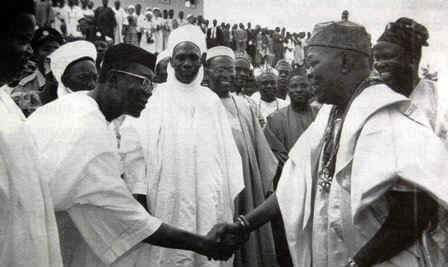
| The Governor congratulating the Premier after the swearing-in |
Cracks
began to appear on the walls of the Action Group immediately after Chief Ladoke
Akintola became the premier. He was sworn in by the Governor, Oba Tadenikawo
Adesoji Aderemi.
In deference to the exalted throne and position of Oba
Adesoji, the newly installed Premier took off his cap to shake hands with the
Governor-King. It was a vintage expression of Yoruba tradition!
Oba lo ba lori ohun gbogbo!
Following series of political actions and decisions taken by the new Premier who was
also the Deputy Leader of the Party, it dawned on Chief Obafemi Awolowo, the
Leader of the Party that Chief Akintola was “determined to run the show alone regardless of accepted Party
conventions and procedure”.
These
actions, according to Chief Awolowo, include the unilateral appointment of
Ministers into the Cabinet of Western Region, reduction in the price of cocoa,
reducing flat-rate tax from an average of #4.17.6d, exemption of women from
taxation, and increases in Assumed Local Contributions in Western Nigeria’s
secondary grammar schools, amongst others.
More
importantly, Chief Akintola was of the view that the experiment of separating
the leadership of the Party from the leadership of the Government in the
Western Region had failed. What was left unsaid was that the Premier ought to
be the Leader of the Party.
 |
| Chief Obafemi Awolowo |
By
the time the Party came back from its Jos Convention, it was clear to all and
sundry that the festering wound of the Action Group had become an open sore.
Agba kii wa loja ki ori omo tuntun wo. Elders won't allow the neck of a newborn to go askew. On
February 9, 1962, the Ooni of Ife, Oba Adesoji Aderemi called a peace meeting
of the party leaders in order to resolve the differences between the two great
men. The Ooni was supported in this regard by some leading Obas and Chiefs in
the region. The meeting however failed to conclusively effect a settlement.
It was becoming apparent that something must give. Àgbò meji ko le mu omi ninu koto kan naa.
It is impossible for two rams to peacefully drink from the same saucer at the
same time.
On
May 19, 1962, at a meeting of the Executive Committee of the Action Group,
Chief Obafemi Awolowo levelled three charges against Chief Ladoke Akintola. The
Leader accused the Deputy Leader of maladministration, anti-party activities,
and indiscipline. In support of the charges, Awolowo spoke for four hours. In
his defence, Akintola denied the charges and spoke for three hours.
 |
| Chief Samuel Ladoke Akintola |
The
jury of party executives listened to both the plaintiff and the defendant. A
motion calling on Akintola to resign as the Premier was moved. The defendant’s
group moved a counter-motion for the Premier to only be reprimanded and not
removed. The counter-motion was defeated. The motion for the premier to resign
was carried by 81 to 29! The meeting had lasted for 11 straight hours!
The
party leadership waited patiently for Akintola’s letter of resignation. No
letter was forthcoming. A ti ki òjé bo
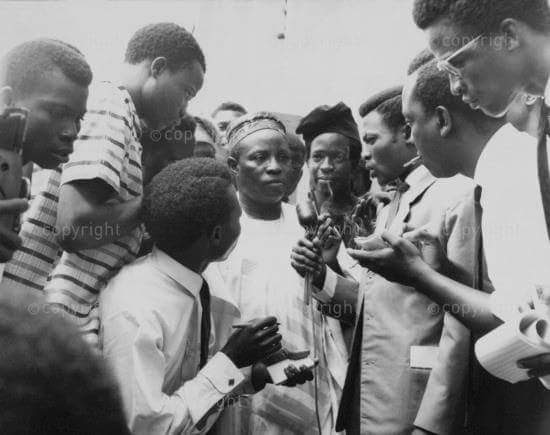
oloosa lowo, o ku baba eni ti o bo. Who is going to remove the charmed bracelet from the wrist of a chief priest? Akintola called a Press Conference and
announced that he was not going to resign his post as the Premier. Instead of a letter of resignation, the embattled premier wrote two letters. The first
letter was to the Ooni, asking the Governor to dissolve the House of Assembly.
The second letter was to the Speaker of the House calling for an emergency
meeting of the House for a vote of confidence or otherwise.
 |
| Sir Adesoji Aderemi back home at his Palace |
The
Ooni and the Speaker were perplexed. How could the House be dissolved and a
meeting of the House still be called at the same time? O
pe laye, oju re ko ni ri ibi, ikan ni eniyan yoo fi owo mu. It is either you live long and witness unsavoury things or die young and experience nothing. It was either
for the House to be dissolved or for a meeting of the House to be called.
Awolowo
was a legal practitioner. Akintola was a legal practitioner. They were both brilliant men
trained in the finest tradition of the British Bar. They were both familiar
with the Constitution of the Federation of Nigeria and the Constitution of Western
Region (Yes, the Regions had their own constitutions then). They were also familiar
with the common law of England as well as parliamentary practices in the
Commonwealth. The question before Awolowo and the Party was how could a premier
be removed from office? The issue before Akintola and his group was whether a
premier could be removed from office.
 |
| Chief Obafemi Awolowo with his son, Wole |
Awolowo
knew that a barber needed another barber to barb his hair. He did the most
natural thing. He requested two of the most brilliant legal minds in the Region to prepare a legal advisory for the Party. Chief Rotimi Williams, the Legal
Adviser of Action Group and Mr. S. O. Ighodaro, the Attorney General of the
Western Region accepted the assignment.
The
two legal giants spent sleepless nights consulting books of laws from various
jurisdictions. The contentious provision itself was simply worded. It was the
proviso to section 33(10) of the Constitution of Western Nigeria which provides
that:
“The Governor shall not
remove the Premier from office unless it appears to him that the Premier no
longer commands the support of a majority of the members of the House of Assembly.”
Simple?
Not quite!
The
duo of Williams and Ighodaro were of the firm opinion (your lawyer will tell
you that there is a difference between an opinion and a firm opinion) that the operative words in the provision were ‘unless it appears to him’. The legal experts
concluded that as long as it appeared to the Governor in any form or format,
the premier could be removed. It did not even have to be on the floor of the
House.
Armed
with this legal advice, a form was prepared and members of the House who wanted
Akintola to be removed as the Premier appended their signature. They were 66 in
number. The form was sent to the Governor, His Royal
Majesty, the Ooni of Ife.
Based
on the signatures of 66 members out of 112 as contained in the form forwarded
to the King, it then appeared to the Governor
that the Premier no longer commanded the support of a majority of the members
of the House of Assembly. The Governor exercised his constitutional power!
Sir
Adesoji Aderemi removed Chief Ladoke Akintola as the Premier!
 |
| Men of History |
Akintola
was in the Premier’s Office when he was served with a letter from the Governor
removing him from office. The premier who had just been removed as the premier
did three things immediately he finished reading the letter.
He
called a Press Conference to inform the world that he was still the premier.
He
then called on the Prime Minister, Sir Abubakar Tafawa Balewa, to remove Sir
Adesoji Aderemi as the Governor.
Finally
he filed an action in court to restrain the Governor from removing him from office.
The
Awolowo group was also not idle. Immediately they were informed that the
Governor’s letter had been delivered to the ‘ex-premier’, the party’s
Parliamentary Group elected Akintola’s Minister of Local Government, Alhaji
Dauda Soroye Ishola Adegbenro, as the new premier of Western Region.
The
Governor was informed of the new appointment. Oba Adesoji Aderemi accepted the
recommendation and His Royal Majesty promptly administered the oath of office
to the new Premier. Alhaji Dauda Adegbenro, the Ekerin of Egbaland and the Balogun of Owu, had become the Premier! The Commissioner of
Police soon arrived. He pledged his services to the new Premier.
The
Commissioner of Police was just leaving the newly installed premier when a signal came from
Lagos. He was directed to ‘forthwith withdraw his services, and should take no
instructions whatsoever from Adegbenro’.
The
people of Western Region woke up on that fateful day in May to find out that
they had two Premiers. On one hand was Chief Akintola who was claiming that his
removal as the Premier was ineffectual. On the other hand was Alhaji Adegbenro
who had just been sworn in as the Premier and who had appointed his cabinet
members.
Akintola Ta ku [Akintola Remains
Adamant] was the headline of The Daily
Times.
Across
the Atlantic, the New York Times came
out with a banner headline: Nigerian Leader
Resists Ouster: Fights Removal As Premier of Western Region. According to
the paper: “Samuel L. Akintola has
stubbornly refused to accept his dismissal as Premier of Nigeria’s Western
Region.”
On
May 23, 1962, the Western Region High Court in Ibadan was filled to capacity.
It was the case of the century. The Governor had removed the Premier. In turn,
the Premier had asked the Prime Minister to sack the Governor. The new Premier,
Alhaji Adegbenro, was however not a party to the case at this stage.
The
Chief Justice of the Western Region then was My Lord Justice Samuel Quarshie-Idun.
(At the time, head judges of the regions were also called Chief Justices. They
are now addressed as Chief Judges). Of course you know Mr. Justice
Quarshie-Idun now. That was the trial judge in the case of Adegoke Adelabu! Ha!
You remember him now! His Lordship was however not in Ibadan at the time the
suit was filed. The CJ was on tour of the Midwest area of Western Region.
Justice Olujide Somolu quickly sent message to His Lordship to come back to
Ibadan for the very important case.
 |
| Mr. Justice Quarshie-Idun |
Chief
Akintola’s legal team was led by a Queen’s Counsel, Chief Ladipo Moore, the brilliant
son of the legendary lawyer, Eric Olawolu Moore. (You know Eric Moore Road in
Surulere, Lagos? The street is named after the formidable advocate). Eric
Moore’s daughter, Miss Kofoworola Moore (later Lady Ademola), was married to
Sir Adetokunbo Ademola, the Chief Justice of the Federation. Lady Ademola was
reputed to be the first black African woman to earn a degree from Oxford
University.
The
Ooni was also represented by a Queen's Counsel, the indomitable Rotimi Williams whose brilliance was unparalleled. Of him, Chief Awolowo said: "Timi's output, in any assignment, was always as big as his physical stature."
The proceedings had
hardly begun when Chief Akintola’s counsel fired the first salvo. Chief Moore objected
to the competence of Chief Williams to appear for Sir Adesoji Aderemi. The
Court agreed with his submission. Chief Williams was refused permission to
continue to act as counsel for the Ooni. The Governor promptly instructed
another brilliant counsel, Barrister Akinyele to lead his defence.
It
was at this stage that Chief Ladipo Moore advised his client on the need for
them to join Alhaji Adegbenro as a Defendant. Immediately he was joined, Alhaji
Adegbenro filed a counter-claim against Chief Akintola. It was now a case of
Two Premiers and a Governor! Where would the pendulum swing?
 |
| Alhaji Adegbenro - The Ekerin of Egbaland |
Whilst
the case was going on, Alhaji Adegbenro had moved into the Premier’s Office.
He had started functioning as the Premier and he was also using the Premier’s
official car. In fact, when he was later restricted under the Emergency
Regulations, it was the official car of the premier that took him to Osogbo,
his place of restriction.
On
the adjourned day, Chief Moore argued his application for injunction to
restrain Sir Adesoji Aderemi from purporting to relieve Chief Ladoke Akintola of his office as
premier in the absence of a resolution of the House of Assembly. The motion was opposed by Mr. Akinyele who
argued that to the extent that Chief Akintola was no longer the premier, there
was nothing for the court to restrain. It was classical advocacy at its best.
His
Lordship listened to the arguments from the two brilliant advocates. It was
indeed a very difficult case. The Court then made two rulings. In respect of
Chief Akintola’s motion, His Lordship granted the injunction prayed for by the
man who would later become the Aare Ona Kakanfo of Yorubaland.
Justice Quarshie-Idun ordered Alhaji Adegbenro not to assume the office of
Premier. In other words, Chief Akntola was to continue in office. At least,
pending the determination of the suit itself.
With
regard to the substantive suit, the Chief Justice referred the case to the
Supreme because of its grave constitutional importance.
At
the Supreme Court, it became a battle Royale! The apex Court itself admitted
that it was being “called to perform a difficult duty.” Something like that had
never happened before. There was no precedent to be followed.
The
Supreme Court then did something. It invited all the Attorneys General in the
country to appear as amici curiae. Onigegewura
had already explained the meaning of this expression in Sunny Ade’s story. It was however only the Eastern Nigeria Attorney
General that sent his Solicitor General to assist the court.
Four
Lord Justices sat to hear the case. Sir Adetokunbo Ademola, a Prince of
Abeokuta and a Knight of the British Empire, presided as the Chief Justice of
the Federation. Also on the panel was Honourable Mr. Justice Lionel Brett, a
World War II veteran, who was the last expatriate to serve as Nigeria’s
Solicitor General. Mr. Justice Idowu Taylor was also on the panel. The
Magistrate Court Complex at Igbosere, Lagos is named after him. Another Knight,
Sir Vahe Bairamian, was the fourth Justice.
The
question before the Court was whether the Governor could remove the Premier
based on a letter signed by a body of members of the House and not as a result
of a vote of no confidence on the floor of the House. In other words, how would
it appear to the Governor that the
premier no longer enjoyed the support of the majority of parliamentarians?
After
exhaustive deliberations, My Lord Justice Adeokunbo Ademola held that the
Governor exceeded his constitutional powers. According to His Lordship: “The Governor cannot validly exercise power
to remove the Premier from office except in consequence of proceedings on the
floor of the House.” Justices Taylor and Bairamian agreed with His
Lordship.
My
Lord Justice Brett, the World War II veteran, was however unable to agree with
the reasoning of the majority. In his dissenting judgment, the former Solicitor
General of Nigeria held that: “the
Constitution does not preclude the Governor from acting on any information
which he considers reliable.”
Chief
Akintola’s group erupted with happiness. Official’s
Removal Reversed in Nigeria screamed the New York Times’ headline of July 8,
1962.
 |
| SLA |
Chief
Akintola, the master linguist, didn’t allow the moment to go without poking fun
at his opponent. The middle name of Alhaji Adegbenro is Soroye which could be
literally interpreted to mean ‘do you see
honourary title?’. According to
various accounts, Chief Akintola quipped: Sóoróyè kii je oye. Yio ma roye ni, ko ni je oye. (‘Do you see honourary title can
only see title but he cannot become a titleholder!).
Onigegewura
had earlier told you in Adelabu’s story
that the Federal Supreme Court was not the final court of appeal at the time.
Alhaji Adegbenro appealed to the Privy Council in London.
On
May 27, 1963, the Judicial Committee of the Privy Council delivered its
judgment. Five Lord Justices heard the appeal which had come all the way from
the Federal Supreme Court of Nigeria.
I
hope you recall that Chief Rotimi Williams and Mr. Ighodaro had opined that the
Governor could exercise his power to remove the Premier as long he was
convinced that the premier no longer commanded majority support. I hope you
also remember that the dissenting judgment of Brett FJ agreed with this
reasoning. That’s good. It shows that you are following me.
The Privy
Council held that the Federal Supreme Court misapplied the law. The PC agreed
with the legal opinion of Chief Williams and Mr. Ighodaro. The Council
therefore allowed the appeal and reversed the majority decision of Ademola,
Bairamian and Taylor. The council upheld the minority decision of Brett FJ. In
effect, the Council held that Oba Adesoji Aderemi exercised his power to remove
Akintola constitutionally!
Adegbenro
has won!
 |
| Alhaji DS Adegbenro |
The
Privy Council did not stop there. It also directed Chief Akintola to pay Alhaji
Adegbenro the sum of #1,140:8s: 5d as the costs incurred in prosecuting his
case from Nigeria to the United Kingdom.
This
time around, it was the turn of Alhaji Adegbenro’s group to erupt with joy!
But
it was a short-lived joy. As the Privy Council Lord Justices were signing off
on their judgment in London, something was happening back home in Nigeria. On
the same day, the Western House of Assembly amended its constitution.
I
hope you have not forgotten that the decision of both the Supreme Court and the
Privy Council was based on the proviso to section 33 (10) which Onigegewura had
quoted above. Minutes after the Privy Council had announced its decision, the
provision was amended by adding the following phrase: “…in consequence of the passing of a resolution in the House of Assembly
by a majority of the members of that House”.
That’s
not all. The amendment was also backdated by three years. It was deemed to have
taken effect from October 1960! I hope you are not becoming confused with the
legal theatrics. In other words, the decision of the Governor taken in 1962 was now null and
void because it was not in consequence of the passing of a resolution in the
House of Assembly by a majority of the members of that House! The decision of
the Privy Council delivered in 1963 was also of no legal effect.
The long and short of it is that Chief Akintola had
never been removed as the Premier! Legally speaking!
Adegbenro
had scored his goal in London. Unfortunately, the goal post had been moved in
Ibadan. Ibadan lo mo, o mo láyípo!
That
however was not the end of the story.
Alhaji
Adegbenro, the Ekerin Egba, had lost the premiership but he was not about to lose the costs awarded
in his favour by the Privy Council. He filed an application at the Supreme
Court of Nigeria for the Court to direct the Premier to pay him his costs. He
was represented this time by Chief Akin Olugbade. Chief Akintola was
represented by Chief Moore.
Chief
Akintola argued that he should not pay any costs because his government had
nullified the decision of the Privy Council. The court disagreed. The apex
court found merit in the application of Alhaji Adegbenro. After all, aya òle la n gba, ko si eni ti o n gba omo òle. A lazy man can only lose his wife and not his child. The court ordered Chief Akintola to pay Alhaji Adegbenro the costs
incurred in the Supreme Court of Nigeria and the sum of #1,140:8s: 5d being the
costs of his appeal to Privy Council in England. Onigegewura is able to confirm
that Chief Akintola paid the costs.
The
story did not end there…
You are wondering why appeals were still being taken to the Privy Council notwithstanding Nigeria's status as an independent country. Onigegewura will tell you the reason. It was because the
country remained a Commonwealth Realm with the Queen as her Head of State. Nigeria was not yet a republic.
Following the decision in the Akintola case, Nigerian
Government felt the time had come to become a full republic. Ti a ba fi agbo fun egun, a fi okun re le ni. When you give a ram to the masquerade, you ought to leave the rope. Why was Her Majesty still holding on to the rope after giving us the ram? The time had come to cut the political umbilical cord. The 1963 Republican Constitution was promulgated. With that singular act, Nigeria became a Republic and
appeal to Privy Council was abolished. The Supreme Court became the final court
of appeal for the Federal Republic of Nigeria.
And
it all started with that midnight call.
That
however was not the end of the story…
I
thank you very much for your time.
-Olanrewaju
Onigegewura©
The right of Olanrewaju Onigegewura© to be identified as the author of stories published on this blog has been asserted by him in accordance with the copyright laws.